

An institution’s award-winning brand does not automatically transfer to the individual holding the scalpel. Here’s why the building may not be the bet you think it is.
———————–
When you or a loved one faces a major surgical diagnosis, the first instinct is almost always to search for the “best hospitals for surgery” in your area. You look for the massive banners hanging outside medical centers, the shiny digital ads, or the definitive stamp of approval from mainstream publications like the U.S. News & World Report hospital rankings.
It makes intuitive sense: a world-class building should equal world-class care.
But behind those multi-million-dollar healthcare marketing campaigns lies a quiet, systemic truth that every patient needs to know: an institution’s award-winning brand does not automatically transfer to the individual holding the scalpel inside the operating room.
To get the safest, highest-quality care, you have to look past the billboard. You have to understand the massive difference between hospital ratings and surgeon ratings.
Are U.S. News Hospital Rankings Accurate?
To understand why hospital ratings can be misleading, you have to look at what they actually measure. Mainstream hospital ranking systems are macro-level evaluations. They aggregate data across entire institutions, heavily weighting factors like:
- The hospital’s overall reputation among surveyed physicians.
- Advanced institutional technologies, like specialized ICU equipment.
- Patient survival rates averaged across thousands of total admissions.
- Nursing staff ratios and general patient satisfaction scores.
While these metrics are excellent for understanding if a hospital is well-funded, clean, and structurally sound, they completely blur the lines when it comes to individual surgical performance.
A hospital might receive an “Honor Roll” rating because its cardiology and oncology departments are revolutionary, while its orthopedic or general surgery departments simultaneously possess clinical outlier risks. The macro average completely hides the micro reality.
The Core Differences
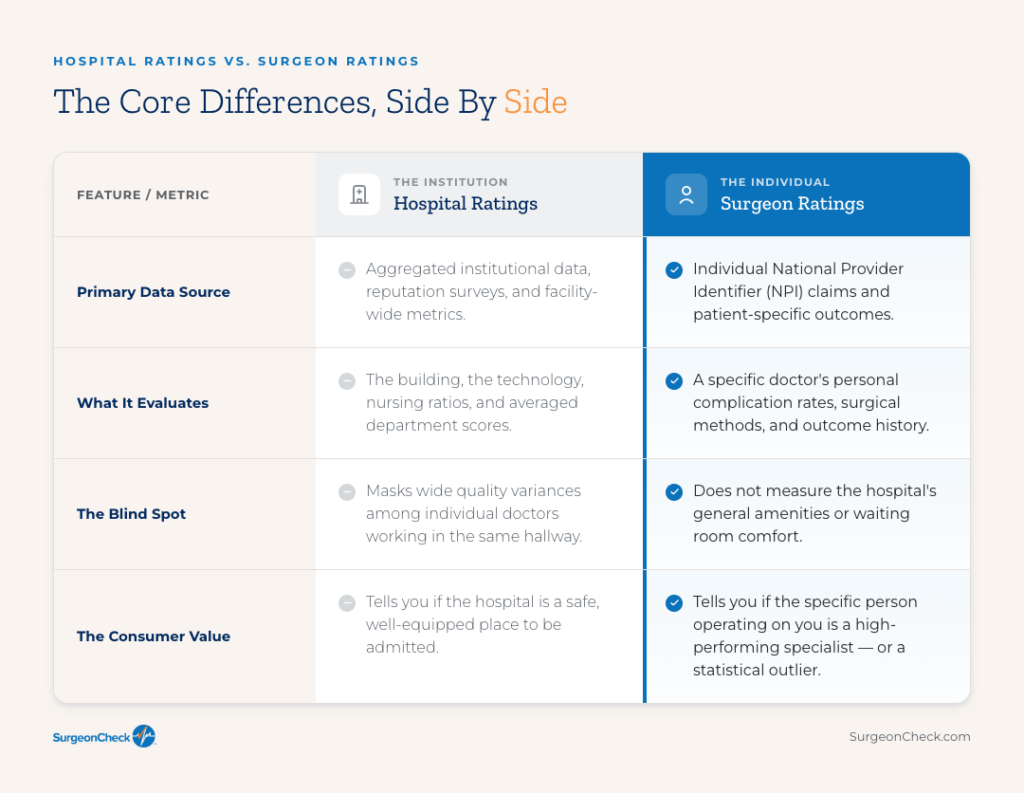
When you select a facility based on a broad hospital rating, you are betting your health on an institution. When you select a provider based on a surgeon rating, you are betting on the actual human performing your procedure. Here is how the two evaluation systems stack up:
The Hallway Variance: One Building, Two Standards Of Care
In my 13 years as a Chief of Surgery, I witnessed this phenomenon firsthand. Within the exact same highly rated, highly decorated hospital building, wide quality variances exist from doctor to doctor. On any given Tuesday, you could have two operating rooms running side-by-side:
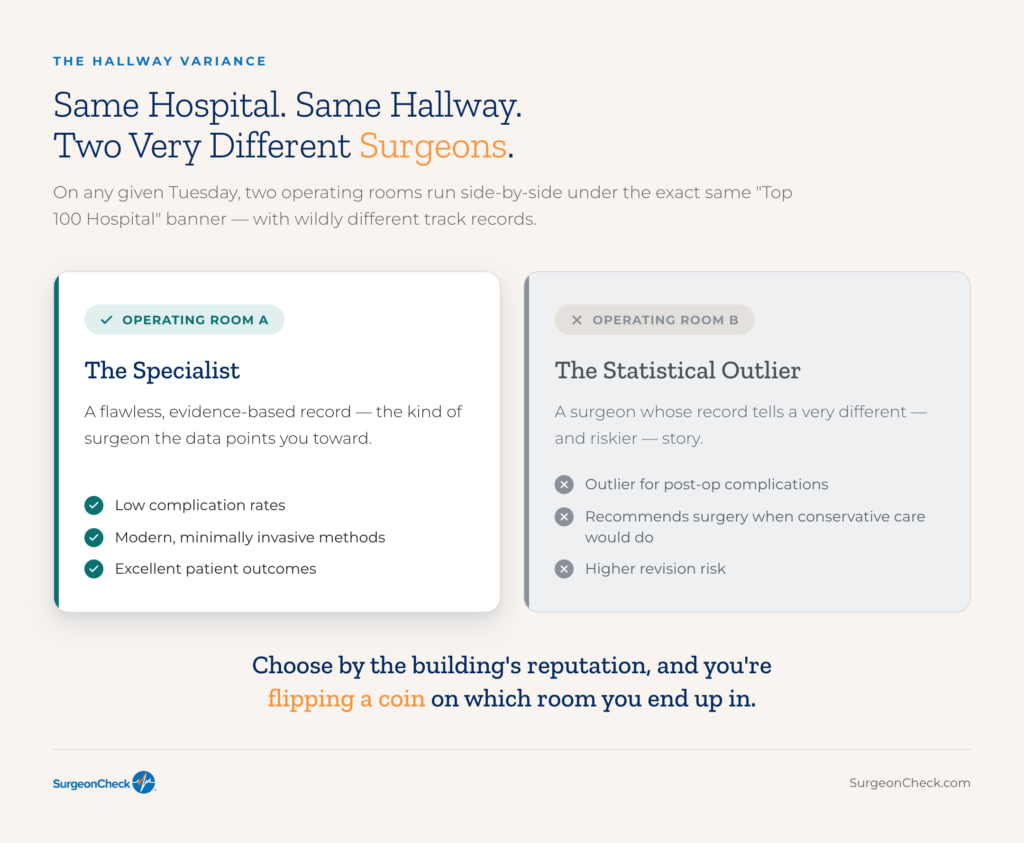
Both of these doctors work under the exact same “Top 100 Hospital” banner. If you choose your doctor based entirely on the building’s reputation, you are essentially flipping a coin on which operating room you end up in.
The hospital brand doesn’t perform your procedure.
The individual surgeon does.
How To Protect Yourself: Move From Building To Person
True healthcare transparency means moving away from institutional marketing and leaning directly into objective, evidence-based data — down to the individual doctor level.
Next time a provider recommends a procedure, don’t just ask, “Which hospital should I go to?” Take control of your healthcare journey by asking the next, more important question: “What does the data say about this specific surgeon?”
At SurgeonCheck, we believe patients shouldn’t have to fly blind. We’ve analyzed billions of medical claims to evaluate individual surgeons across 20+ specialties based on what actually impacts your life: real complications, actual patient outcomes, and clinical appropriateness.
Stop Picking The Building.
Start Picking The Person.
Find a high-quality surgeon at surgeoncheck.com/.