

You’ve decided to get your knee replaced. After months or years of pain, you’re ready to get your life back. But as you research surgeons, you might wonder: does it really matter who does my surgery?
The answer might surprise you. Your surgeon’s skill affects your pain levels, mobility, and recovery time. We understand this decision feels overwhelming. But here’s something that can give you confidence: the right surgeon, combined with your commitment to recovery, can mean walking normally in three weeks. The wrong choice might mean struggling with a walker for months.
What makes a surgeon “top-performing”?
Let’s be clear about what we mean by surgeon performance. At SurgeonCheck, we study millions of patient outcomes. We find surgeons who consistently get superior results. These aren’t just busy surgeons. They’re surgeons with proven track records of:
- Lower complication rates for your specific procedure
- Better long-term outcomes tracked over the years
Unlike other rating systems, we never take payment from surgeons. Our evaluations are based purely on what happened to real patients like you.
The 3-week vs. 3-month recovery: what makes the difference
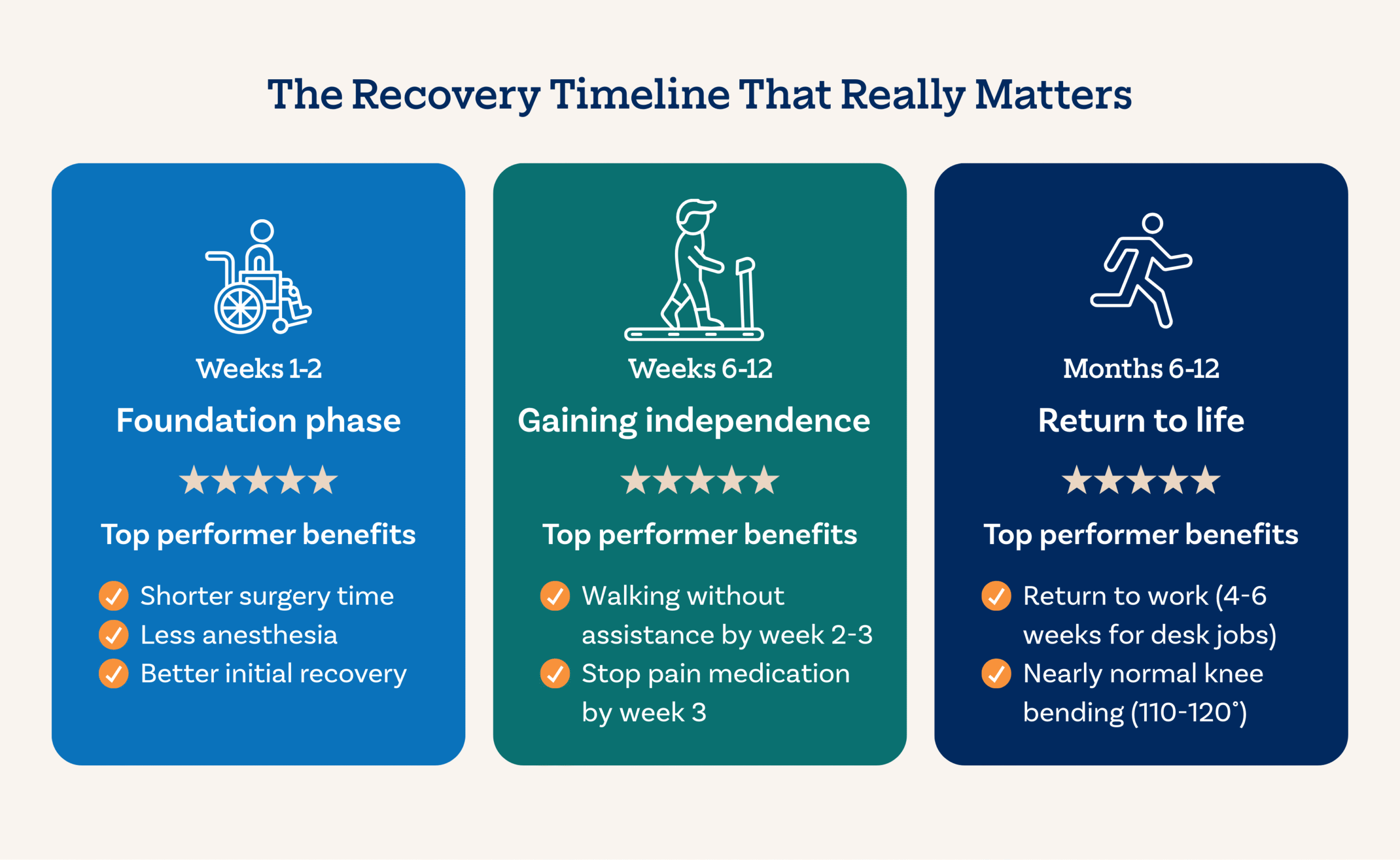
Every patient’s journey is unique. But understanding typical recovery milestones helps you know what to expect. It also helps you know what to ask your surgeon about their patients’ experiences.
What You Can Expect:
- Walking short distances with a walker or crutches
- Moderate pain that decreases steadily with proper care
- Beginning gentle bending and straightening exercises
- Hospital stay of 1-3 days for most patients
How Surgeon Skill Makes a Difference:
Experienced surgeons typically do procedures more efficiently. They also have fewer complications. This can lead to:
- Less time in surgery and under anesthesia
- Lower risk of complications that slow healing
- Better initial recovery experiences
But your recovery success depends on both the surgeon’s skill AND your commitment to the healing process.
Your Role in This Phase:
- Follow all post-surgery instructions carefully
- Do prescribed exercises
- Use ice and elevation to manage swelling
- Take pain medication as directed to enable movement
This phase is where you’ll really start to feel like yourself again. It’s also where surgeon skill becomes most clear.
What You Can Expect:
- Walking without a walker or crutches (many patients achieve this by week 2-3)
- Much less pain—most people stop prescription pain medication by week 3
- Bending your knee to nearly 100-110 degrees
- Return to driving (typically 4-6 weeks, depending on which knee was replaced)
The Surgeon Impact:
Here’s where the differences become really clear. National patient databases show something important. Patients of lower-quality surgeons have much higher infection rates during this critical healing period.
An infection during this phase doesn’t just mean antibiotics. It can mean additional surgery. It can mean extended recovery time and months of setbacks.
Meanwhile, patients of top performers are typically ahead of schedule. They’re walking confidently. They’re sleeping better. They’re feeling optimistic about their progress.
Your Critical Role:
Your daily choices during this phase significantly impact your outcomes:
- Physical therapy commitment: Attend every session and do home exercises
- Activity progression: Follow guidelines for increasing walking
By now, you should feel much more like your old self. Or better than you have in years.
What You Can Expect:
- Return to work (4-6 weeks for desk jobs, up to 3 months for physical work)
- Bending your knee nearly normally (110-120 degrees)
- Much less pain and swelling
- Beginning light activities you enjoy
Why Your Surgeon Choice Matters Here:
Patients of high-performing surgeons are more likely to stay on track during this phase. They have shorter hospital stays (nearly half a day to two full days less on average). They also have fewer complications that could slow their progress.
Your Partnership in Success:
Even with the best surgeon, your recovery depends heavily on your commitment:
- Work consistency: Return to work gradually and listen to your body
- Exercise progression: Push through discomfort but respect pain signals
- Lifestyle adjustments: Modify activities to protect your healing knee
- Communication: Keep your surgical team informed about progress and concerns
This is when you’ll truly appreciate your decision to have surgery. You’ll also appreciate your choice of surgeon.
What You Can Expect:
- Return to activities like biking, swimming, or golf
- Very little discomfort during daily activities
- Nearly normal knee bending and movement
- Confidence in your knee’s stability and strength
The Long-Term Advantage:
Here’s something most patients don’t realize. Your surgeon’s skill affects not just your next few months. It affects your next few years.
Data shows something important. Patients treated by lower-quality surgeons have a significantly higher chance of needing additional surgery within a few years. This means choosing the right surgeon now affects whether you’ll worry about your knee again down the road.
Your Long-Term Commitment:
The best surgical outcomes require ongoing partnership:
- Activity modification: Learn which activities to embrace and which to avoid
- Weight management: Maintain a healthy weight to reduce knee stress
- Strength maintenance: Continue exercises to support your new knee
Ready to research knee surgeons with proven track records?
Your role in recovery success
While surgeon selection is crucial, your recovery is ultimately a partnership. The most successful patients understand that great outcomes require both skilled surgical care and dedicated self-advocacy.
Before surgery: setting yourself up for success
- Physical preparation: Strengthen your legs and improve flexibility
- Health optimization: Manage diabetes, blood pressure, and other conditions
- Lifestyle changes: Stop smoking, maintain a healthy weight
- Education: Understand what to expect and how to prepare
During recovery: your daily choices matter
- Exercise commitment: Physical therapy isn’t optional—it’s essential
- Pain management strategy: Use medication to enable movement, not avoid it
- Nutrition focus: Eat protein-rich foods to support healing
- Rest and recovery: Balance activity with adequate sleep
Signs you’re being an active recovery partner
- You ask questions during medical appointments
- You complete exercises prescribed
- You track your progress and celebrate small wins
- You communicate honestly with your care team about challenges
The patients who achieve the best outcomes combine excellent surgeon selection with personal commitment to the recovery process.
Real recovery differences you’ll experience
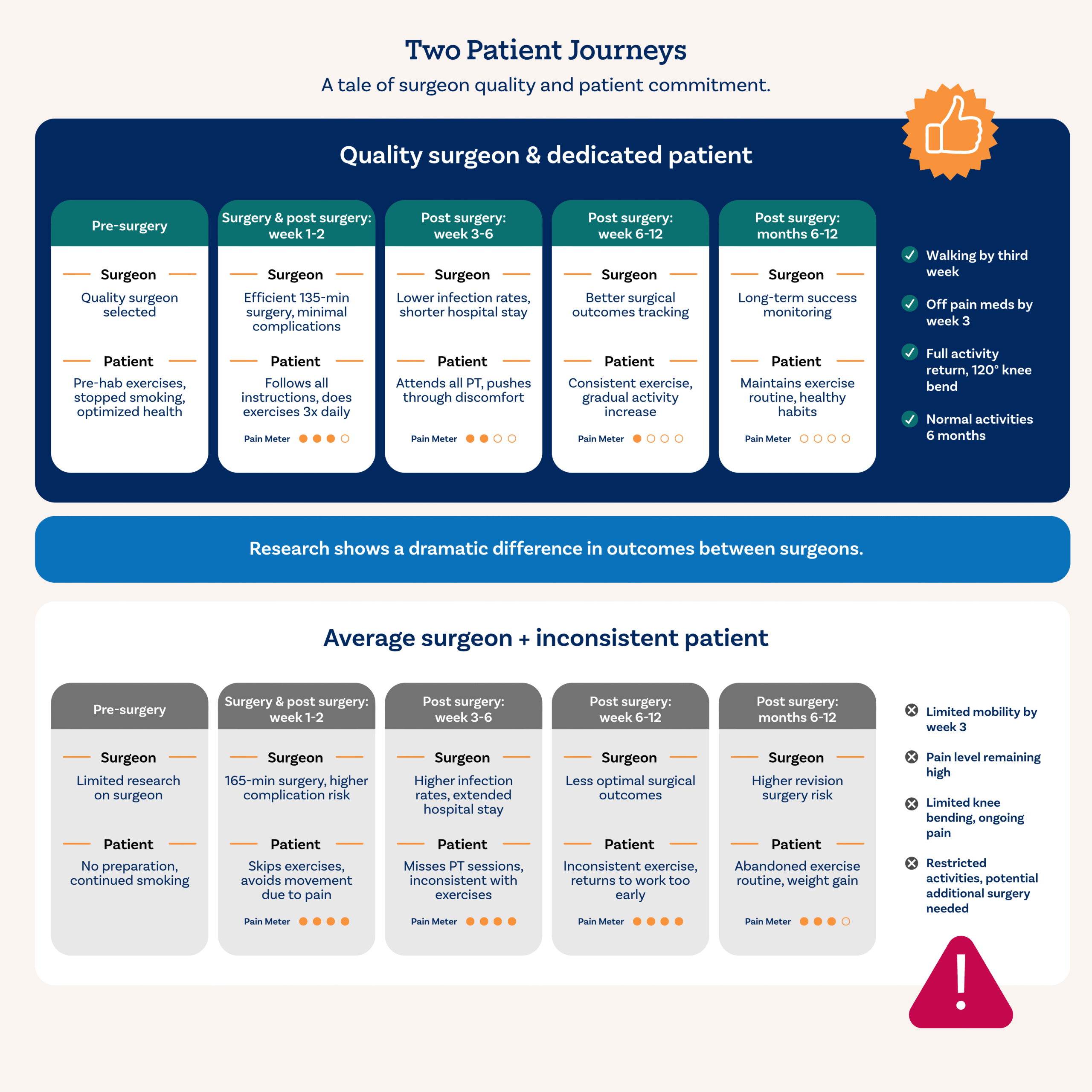
Let’s put this in perspective. Here are real differences that matter to your daily life:
Walking Independence:
- Patients of top performers and active physical therapy: Often walking without help by 2-3 weeks
- Average outcomes: May need a walker or cane for 4-6 weeks or longer
Pain Management:
- With skilled surgeons: Most patients stop prescription pain medication by week 3 and sleep well
- Less optimal outcomes: Extended pain medication use and interrupted sleep for months
Return to Activities:
- Best outcomes: Back to activities you love within 2-3 months
- Average results: May take 4-6 months to feel confident doing normal activities
Bending Your Knee:
- Top performers: Patients typically achieve nearly normal bending (110-120 degrees) by 6 weeks
- Concerning patterns: Some patients struggle to bend even 100 degrees and need more procedures
Questions that reveal surgeon quality
Understanding how your surgeon’s experience affects your recovery helps you make a better decision. We recommend asking:
- “What’s your average surgery time for my type of knee replacement?”
Why this matters: Shorter, more efficient surgeries often show experience and reduce complication risk. - “What percentage of your patients are walking without help by three weeks?”
Why this matters: This gives you insight into typical recovery paths for their patients. - “What’s your infection rate for this procedure?”
Why this matters: Top performers should have infection rates well below 1%. - “How many of your patients achieve nearly normal knee bending by six weeks?”
Why this matters: This shows both surgical technique and post-operative care quality. - “What percentage of your patients need more surgery within three years?”
Why this matters: This reveals long-term success and surgical precision.
Print these questions and take them to your consultation. Your surgeon’s comfort in answering them can tell you a lot. The specific numbers they provide can tell you even more about their track record.
Making your decision with confidence
Recovery from knee replacement requires commitment from both you and your surgical team. You can’t control every aspect of healing. But you can control one of the most important factors: choosing a surgeon with a proven track record.
The data is clear. Surgeon skill and experience significantly impact recovery timelines, pain levels, and long-term success. When you’re making one of the most important healthcare decisions of your life, objective performance data should guide your choice.
Ready to find surgeons with proven track records for knee replacement success in your area?
- R. Ravi et al., “Analysis of the relationship between surgeon procedure volume and complications after total knee arthroplasty using a propensity-matched cohort study,” BMJ Open, vol. 11, no. 12, 2021. Available: https://www.ncbi.nlm.nih.gov/pmc/articles/PMC8647593/
- “Knee Replacement Recovery Timeline,” Healthline, Mar. 31, 2020. Available: https://www.healthline.com/health/total-knee-replacement-surgery/rehabilitation-timeline
- “Knee replacement recovery time – tips and timelines,” Practice Plus Group, May 31, 2024. Available: https://practiceplusgroup.com/knowledge-hub/knee-replacement-recovery-guide/
- “Knee Replacement: Surgery Details & Recovery,” Cleveland Clinic, Mar. 20, 2017. Available: https://my.clevelandclinic.org/health/treatments/8512-knee-replacement
- “Range of Motion After Knee Replacement Surgery,” OneStep Digital Physical Therapy. Available: https://www.onestep.co/resources-blog/range-of-motion-after-knee-replacement-surgery
- “6 Things to Know About Recovery After Knee Replacement,” Hospital for Special Surgery, Oct. 25, 2022. Available: https://www.hss.edu/article_knee-replacement-recovery.asp
- R. L. Lau et al., “The role of surgeon volume on patient outcome in total knee arthroplasty: a systematic review of the literature,” BMC Musculoskelet Disord, vol. 13, p. 250, Dec. 14, 2012. Available: https://bmcmusculoskeletdisord.biomedcentral.com/articles/10.1186/1471-2474-13-250